


Primary Languages
Modern Foreign Languages
FRENCH
National Curriculum [2014]: The Purpose of French
Learning a foreign language is a liberation from insularity and provides an opening to other cultures. A high-quality languages education should foster pupils’ curiosity and deepen their understanding of the world. The teaching should enable pupils to express their ideas and thoughts in another language and to understand and respond to its speakers, both in speech and in writing. It should also provide opportunities for them to communicate for practical purposes, learn new ways of thinking and read great literature in the original language.
INTENT
“To learn a new language is, therefore, always a sort of spiritual adventure; it is like a journey of discovery in which we find a new world.” Ernst Cassirer
French Curriculum at Cottesmore
At Cottesmore St Mary we provide a high-quality French curriculum which provides children with the opportunity to develop a love of, a fascination with and a sense of achievement in foreign language learning whilst understanding and responding to spoken and written language, speaking with increasing confidence, fluency and spontaneity, and writing at varying length. The natural links between languages and other areas of the curriculum enhance the overall teaching and learning experience. The skills and ways of learning, therefore, contribute particularly well to our Cottesmore school values of love, believe and achieve.
We ensure that our children can both produce and understand French through listening, speaking, reading and writing. To do this, we implement a systematic approach to the three pillars of language learning: phonics, grammar and vocabulary, to enhance provision. Our aim is that all children will be able to use French phonics when speaking, listening and reading aloud. They will also be able to recognise some of the language patterns of French and how these differ from or are similar to English. By the end of Key Stage 2, our intention is that all children will have developed resilience in language learning, as well as an enjoyment of it, through a challenging scheme of work, which will enable them to be able to manipulate language to speak or write sentences creatively, using prior knowledge of grammar features; with and without a bilingual dictionary.
We have deliberately created a knowledge rich curriculum and have defined the essential knowledge that pupils need to be educated citizens, introducing them to the best of human creativity and achievements. We have spaced knowledge, skills and concepts so that there is coherent flow to allow our learners to gradually build toward mastery and fluency. Topics are carefully sequenced across year groups to allow opportunities for children to make links and build their understanding of French language concepts such as arbitrariness and sociality, and skills in a wide variety of contexts. Links between topics have been identified, so that learning connects into a web of knowledge to ensure retention. We have defined expectations at key end points which are at the end of each curriculum year so we can assess the progress the children are making.
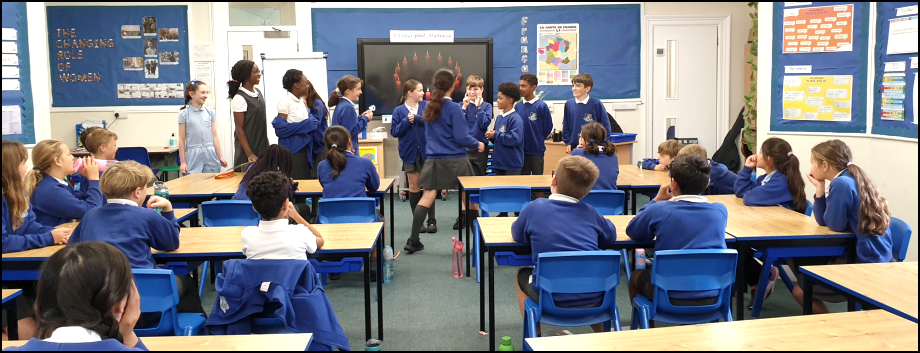
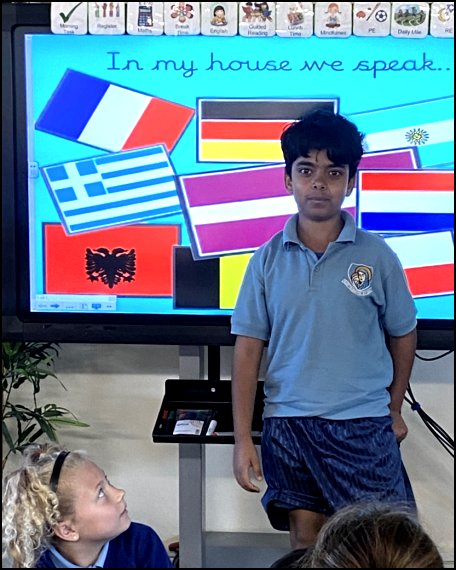
We recognise that the UK is becoming an increasingly multicultural society, and that we have a duty to provide our children with an understanding of other cultures and languages. This is very much reflected in the changing profile at Cottesmore where nearly 24% of children in school now have English as an Additional Language, the National average being 19.5%. Just under 11% of the school is Arabic speaking, reflecting our strong Coptic Christian community but, in total, 22 different languages are spoken by the children. We believe that language lies at the heart of ideas about individual identity and community, and learning another language can play an important role in shaping children’s ideas in this critical area as well as giving them a new perspective on their own language and culture, so we have drawn on the multicultural and multilingual nature of our school to create an engaging and inspiring bespoke French curriculum. It is our aspiration that, through lessons, ‘special events’ and assemblies, all children will leave our school with a deeper understanding of cultural similarities and differences.
French has a high profile at our school and we believe that learning a foreign language not only enhances general communication skills across the curriculum, but also offers an opening to other cultures, thus reinforcing intercultural understanding as well as Catholic and British values. The school is committed to teaching in a creative and academically rigorous way, to support children to develop a mastery of language concepts and inspire enthusiasm in the subject. Lessons make use of a range of materials and media/IT to enhance learning for children and ensure the sound development of the four language learning disciplines of listening, speaking, reading and writing.
Following the COVID pandemic, we recognise the impact that the lack of face-to-face teaching has had on the children’s progress in French. Although lessons were provided as part of our remote learning provision during lockdown, we are aware that we will need to revisit some key concepts from previous year groups.
 xx
xx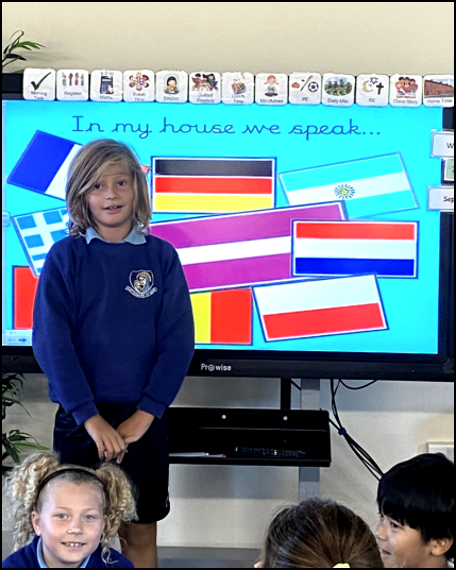
Learning French at Cottesmore fosters children’s curiosity and deepens their understanding of the world. It not only prepares the children for studying the subject at secondary school and in adulthood, but inspires them to understand the relevance of the subject. At our school, French is real and relevant and children learn about what careers paths the subject supports: interpreter, translator, tour guide, hotelier, civil servant, charity worker, international development worker, teacher, national intelligence and security officer, footballer, academic researcher, private tutor, online content creator, international banker, foreign correspondent, arts and heritage manager.
IMPLEMENTATION
What French topics do we teach?
French at Cottesmore is a discrete subject and is taught in half-termly topics with each year group studying six topics every year.
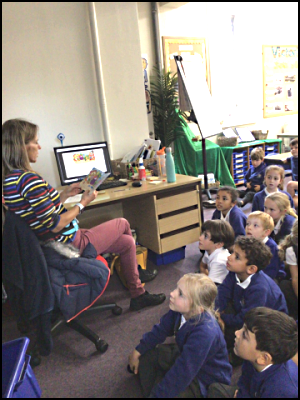
In Key Stage 1 children have the opportunity to join an after-school French club. They hear and respond to the language being used for real purposes, like asking for a biscuit or washing their hands. French club promotes self-confident and curious learners as well as improving children’s memorisation skills and their ability to interpret meaning. They are able to practise the sounds of the new language without feeling self-conscious.
As children move into Key Stage 2 they begin to learn in more detail about how the French language works. Reading and writing are taught from year 3 and children are introduced to the French phonetic system through linking spellings with sound and meaning. They engage in conversation by learning how to introduce themselves, and are further encouraged to use the language through authentic stories, games and songs.
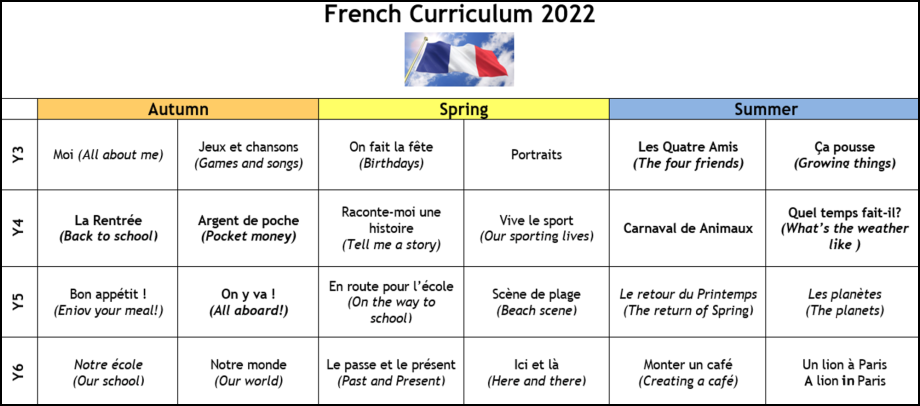 Click on the image to view a larger version

All learning starts with links to prior learning and retrieval practice to encourage retention of knowledge and skills. Learning in each unit is supported by Knowledge Organisers, giving each child a reference point to support acquisition of key vocabulary, grammar and phonics. As, where possible, the language of instruction is French, it is planned carefully in advance with thought given to its complexity and how children’s understanding can be supported with actions, gestures and images, rather than an English translation, and through games, songs, stories and scaffolding tasks. This naturally supports the language-learning of SEND pupils who frequently thrive in the PMFL classroom. Children working at greater depth are challenged through opportunities to model aspects of a lesson, to engage in inventive, ‘no-ceiling’ activities with more than one possible solution, and to give reasons for their choices.
Units in each year group are linked to what the children are learning in other curriculum subjects such as Growing things, the Planets, the Past and the Present and encourage children to speak with increasing confidence, fluency and spontaneity. To ensure depth of understanding, key phonology, vocabulary and grammar are mapped out and revisited throughout the curriculum allowing children to make links across topics and continue to develop their pronunciation and intonation.
French matters, skills and processes are taught together and with a real end purpose so that children learn that French is a real system of communication by which people express their ideas, thoughts and feelings, and through which they understand and respond to each other.
French is taught for approx. 55 minutes per week in Year 3 and 6 and 30 minutes in Year 4 and 5. Lessons are taught by specialists one of whom is a native speaker and the other, a translator and interpreter. Ideally, this language is augmented where possible during the course of teaching and learning across the curriculum and by support materials on the website, as well as enrichment activities through the year where appropriate. In turn, French enhances teaching and learning across other areas of the curriculum through carefully tailored units of work which link to knowledge and skills in different curriculum areas. French plays a key role in supporting English by including focus-specific activities on punctuation, vocabulary and etymology, and phonics and spelling. The units of work support our school commitment to encouraging all children to see themselves as readers by providing access to stories and non- fiction texts in French.
 xxxxxx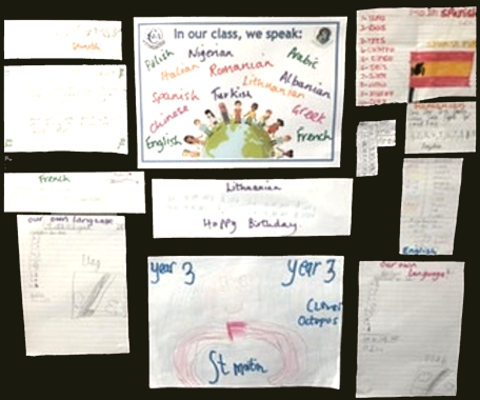
IMPACT
xxx
The MFL subject lead continually monitors the impact that French teaching is having on the children’s learning, through work scrutiny, to ensure the progress of knowledge and skills is being taught. They also ensure the knowledge taught is retained by the children and continually revisited and that children are able to apply the skills they have been taught to a variety of different settings, showing independence with their learning. The impact of the French curriculum is measured through observing children speaking and listening in another language, marking of written work, images and videos of children completing speaking and listening activities, interviewing children about their learning (pupil voice), annual reporting of standards across the curriculum to parents, lesson drop-ins and subject tracking and monitoring.
Assessment in French is carried out through frequent low stakes testing to build memory through repeated recall. This may include knowledge from a previous lesson, or unit and learning from Y3 to ensure basics are secure.
Summative assessment, in the four skills areas of speaking, listening, reading and writing. is used at the end of where a mini-task enables teachers to check children’s ability to produce sentences and manipulate simple structures as well as their understanding and production of vocabulary. Assessments are also used to adapt future units and lessons to ensure that the children have the best opportunity to make progress. Current data shows that 93.94% of children in Y5-6 are at Age-Related Expectation in French.
Challenge in French
Children working at greater depth in French should show flair and curiosity for language and its culture. They eagerly engage in learning new vocabulary, building on their current knowledge and seek to learn new phrases which they can apply within their spoken and written work. They will play with language and develop a greater understanding of grammatical rules and the start to link matching sound words from previous topics.
Assessment opportunities
xxx
Unit 1: Practise a mini-presentation with their partner to introduce themselves. Children may enjoy practising their presentation with a puppet. Invite confident pairs to perform their mini-presentation to the rest of the class. Look for correct pronunciation.
xxx
Unit 2: Create a number frieze for numbers 1-4 or 1-8 for display by drawing characters from Le fermier dans son pré and writing e.g. un fermier / deux chats / trois enfants etc. Children produce a first draft writing from memory.
xxx
Unit 3: Play the game Show Me as a whole class activity and give each child a set of digit cards. Call out a selection of numbers in random order from 1 - 5, 1 - 10, 11 – 20 and finally 1 – 20. Children show understanding by holding the correct number in the air.
xxx
Unit 4: Children use the model text to create colourful self-portraits using black and white A4 copies of their digital portraits. Encourage children to write familiar words e.g. numbers from memory, then using a phrase bank, children complete their descriptions.
xxx
Unit 5: Display extracts from a familiar song, story or poem. Divide the class into groups. Each group takes it in turn to chorus part of a familiar song, story or poem.
xxx
Unit 6: Using word cards, children build a simple sentence to show some understanding of the negative. Give pairs of children cut-up sentences about the market role play to reorder and read aloud. Children practise role-plays in pairs. Confident children show their role-plays to the class.
xxx
Unit 7: Give children the classroom script and ask them to extract simple information.
xxx
Unit 8: Display a selection of toys on the board or pictures to represent them. Working in pairs, children ask their partner e.g. Do want a teddy / ball? Look for children who adjectives to say why c’est fantastique or who can reply using the negative correctly i.e. Je ne veux pas une poupée. NB This activity also shows children’s knowledge of grammar.
xxx
Unit 10: Design a poster about a French sports star using the language they have learned so far. Some children can contribute by labelling pictures with single words, while others will be able to write longer phrases.
xxx
Unit 11: Give children a short description of an animal and ask children to guess which animal it is by extracting simple information
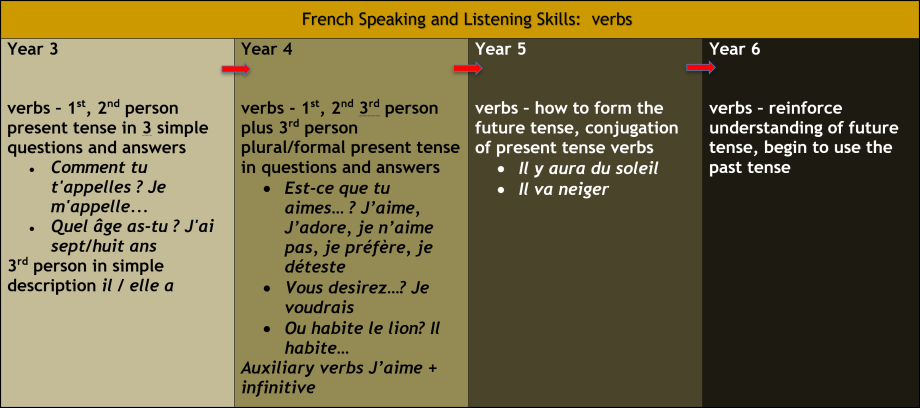
An example of skills progression in French
Supporting your child at home with French
Websites to practise French at home
www.crickweb.co.uk/ks2french.html
www.bbc.co.uk/schools/primarylanguages/french
(for food and drink) primarygamesarena.com/Play/Food-and-drink-in-the-French-l-2127
(for fruit and vegetables) primarygamesarena.com/Play/Fruit-and-vegetables-in-French-2111
www.nicurriculum.org.uk/pl/ (just make sure you take the mute off particularly in stories/rhymes)
www.french-games.net