


Mathematics

xxx
National Curriculum [2014]: The Purpose of Maths
‘Mathematics is a creative and highly interconnected discipline that has been developed over centuries, providing the solution to some of history’s most intriguing problems. It is essential to everyday life, critical to science, technology and engineering, and necessary for financial literacy and most forms of employment. A high-quality mathematics education therefore provides a foundation for understanding the world, the ability to reason mathematically, an appreciation of the beauty and power of mathematics, and a sense of enjoyment and curiosity about the subject’.
xxx
INTENT
Maths Curriculum at Cottesmore
Why our Maths curriculum looks like this:
At Cottesmore, we value a maths curriculum that is rigorous, progressive, coherently sequenced, creative and engaging. We want all children to have access to this curriculum and to make good progress in lessons. Our children need to develop the necessary skills to make them “deep thinkers” acquiring maths skills that can be recalled quickly and transferred and applied in different contexts. They need to be able to make rich connections across the areas of maths and use their knowledge in other subjects, especially Science. The units that the children cover are revisited each year and builds progressively. We want children to realise that mathematics has been developed over centuries, providing the solution to some of history’s most intriguing problems. We want them to know that it is essential to everyday life, critical to science, technology and engineering, and necessary for financial literacy and most forms of employment.
We want our children at Cottesmore to aspire to be: architects, astronomers, accountants, analysts, software engineers, surveyors, computer programmers, statisticians, economists, data scientists of the future- the exciting potential is endless. But predominately, we want the children at Cottesmore to be able to have a firm understanding in how maths is intertwined in everyday life. We want them to be able to understand the importance of running a household effectively and manage money income and save and avoid debt. We want our children to recognise how important maths is in society and especially in less economic countries. Through God’s love, we fund raise for important world causes and give money to charities important to our school. We want our children to dream about making a difference to the world in any area of maths and believe that they are truly blessed in maths and they are our mathematicians of the future.
xxx
IMPLEMENTATION
At Cottesmore St Mary we provide a high-quality Maths curriculum which provides a curriculum for life for all, regardless of background and our ambitious mathematics curriculum plays a vital role in equipping each child with the skills and knowledge needed to take advantage of opportunities in later life. We set high expectations and provide a breadth of expectations throughout their mathematical learning. The vocabulary rich, knowledge engaged curriculum provides children with a deep-rooted understanding and ability to provide reasoning of concepts within the curriculum. We equip the children with the knowledge and skills to apply mathematics, preparing them for their next step in education and aiding them in achieving the minimum grade C or better at GCSE. The practical, talk based and problem solving opportunities that thread through our curriculum equip our children, whatever their social background, the skills required to be an active and positive citizen in modern Britain.
Year Group Overviews
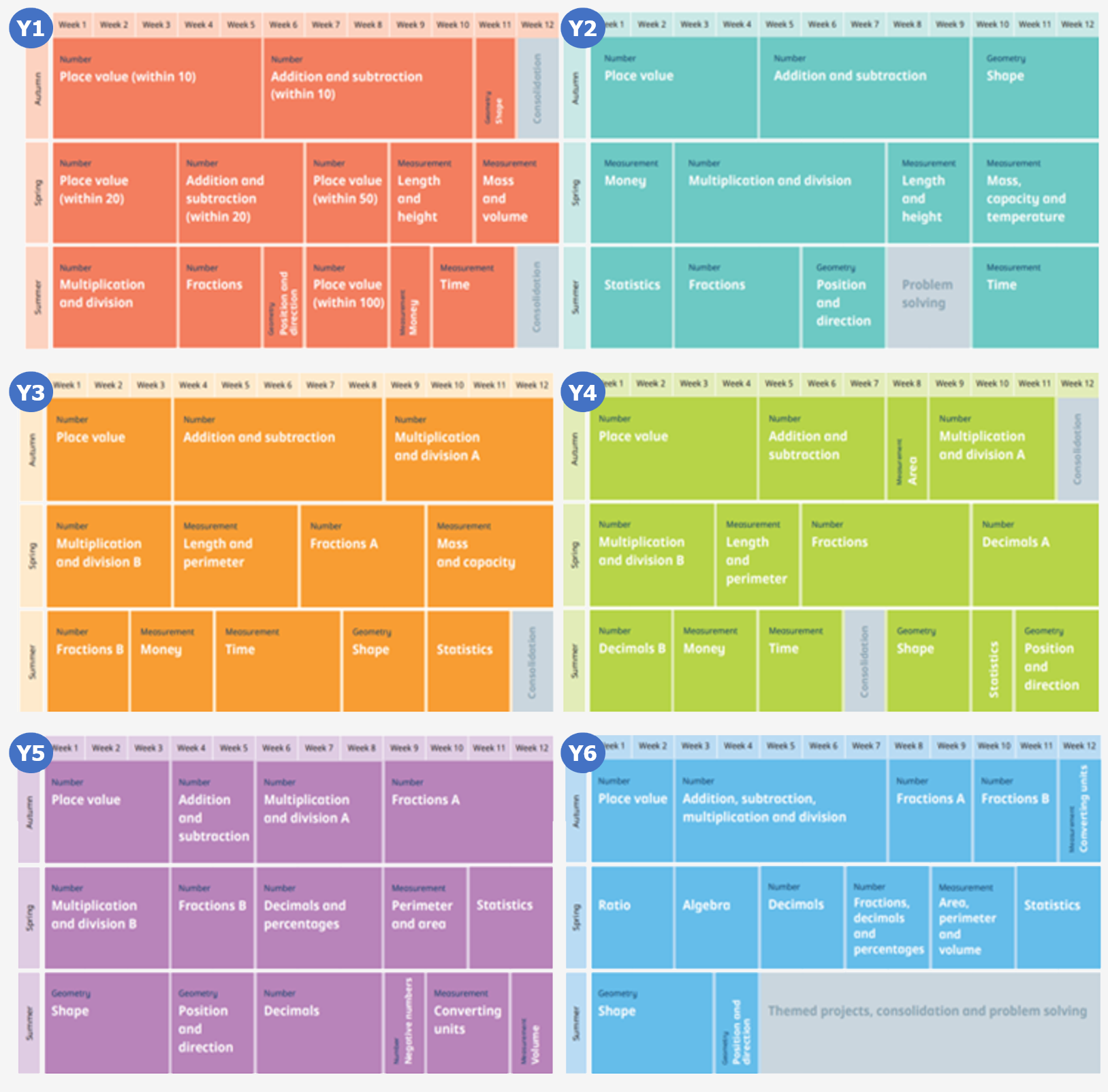 Click the image to view a larger version
Throughout the school, children start every year by covering Number and Place value, progressing onto Addition and Subtraction and Multiplication and Division etc. In every year, children progress through major topic areas of:
Place value - counting, representing, comparing, rounding.
Addition and subtraction - recall, represent, use, calculations, solving problems.
Multiplication and division - recall, represent use, calculations, solving problems, combined operations.
Fractions - recognise and write, compare, calculations, solving problems.
Decimals - recognise and write, compare, calculations and problems.
Fractions, decimals and percentages
Ratio and proportion
Algebra
Measurement - using measures, money, time, perimeter area volume.
Geometry - 2D shapes, 3D shapes, angles and lines, position and direction.
Statistics - present and interpret, solving problems.
We enrich maths at Cottesmore with: enterprise events, links with businesses (Brighton Chamber), Times Tables Rockstars/ Numbots, workshops, problem solving days, competitions and we also work in collaboration with the feeder secondary school, Cardinal Newman to help transition and provide guidance in our teaching for mastery approach. Maths is the foundation for understanding the world and we want our children to know the purpose behind their learning and to apply their knowledge to their everyday lives. As our children progress, we intend for our children to be able to understand the world, have the ability to reason mathematically, have an appreciation of the beauty and power of mathematics, and a sense of enjoyment and curiosity about the subject.
How Maths is taught at Cottesmore: Curriculum
At Cottesmore we follow the WhiteRose Maths planning resources in order to ensure that our children have full coverage of the Maths National Curriculum and to allow our children to revisit topics several times over the year, allowing their knowledge to embed. All children are catered for within maths lessons ensuring that the teacher offers the necessary support and challenge for each individual to make progress. We ensure that maths is taught in a creative and engaging way using a wide array of maths manipulatives to aid and support our children in their learning. Technology is used widely across each year group to deliver the curriculum and to offer the children a range of engaging activities to challenge and inspire. We aim to encourage the deepest reasoning from our children so that their knowledge can be transferred and applied in many contexts including other subject, for example, science and art and their everyday lives. Maths is widely promoted across the school and our classrooms have working walls that the children can utilise to support their learning and provide extra challenge.
A typical maths lesson at Cottesmore consists of the key strands identified in the National Curriculum: fluency, reasoning and problem solving. We follow a consistent lesson approach. We offer the children the opportunity to have varied and frequent practice of their maths skills with the focus on their ability to recall and apply their knowledge rapidly and accurately. Reasoning is a key area in all our lessons as our children need to be able to: describe, explain, convince, justify and prove in order to be successful in this subject. Mathematical vocabulary is an essential part of each lesson and the children need to understand this within the area they are studying and be able to make rich connections across other areas within the subject. Each lesson provides children with the opportunity to reason through their ideas, use their mathematical language to explore a line enquiry and problem solve routine and non-routine problems. We hope to build problem-solvers of the future and build resilience in our children; essential skills they can use in all aspects of their learning. Here at Cottesmore, we offer a wealth of enrichment activities to promote maths within our children’s lives including Times Tables Rockstars and dedicated maths weeks in school (See maths intent for more information.)
Pedagogy
The teachers have a flexible approach to the structure of their lesson so that they can reach the needs of an ambitious maths curriculum. However, all maths lessons have the following key elements:
1. Fluency starter
2. Review of learning- low stake assessments
3. Skills practice- ping pong approach- I do, you do
4. Modelling by the teacher
5. Independent activity- WR sheets
6. Support/ Challenge
7. Plenary/mini review (Pit Stop)
All lessons will cater for the individual needs of the children and to include some element of reasoning and problem solving. Questioning is a key part of the maths lesson- letting the children demonstrate what they know and challenging them every step. The content and principles underpinning the 2014 Mathematics curriculum and the Maths curriculum at Cottesmore, reflect those found in high-performing education systems internationally, particularly those of east and south-east Asian countries such as Singapore, Japan, South Korea and China. These principles and features characterise this approach and convey how our curriculum is implemented:
• Teachers reinforce an expectation that all children are capable of achieving high standards in Mathematics.
• The large majority of children progress through the curriculum content at the same pace.
• Differentiation is achieved by emphasising deep knowledge and through individual support and intervention. For example, concrete and pictorial manipulatives and Master Classes (Next Day Intervention).
• Teaching is underpinned by methodical curriculum design (small step learning intentions) and supported by carefully crafted lessons and resources to foster deep conceptual and procedural knowledge.
• Practice and consolidation play a central role. Carefully designed variation within this builds fluency and understanding of underlying mathematical concepts.
• Teachers use precise questioning in class to test conceptual and procedural knowledge and assess children regularly to identify those requiring intervention, so that all children keep up.
To ensure whole consistency and progression, the school uses the White Rose Maths scheme and the school’s ongoing engagement with the DFE funded Maths Hubs programme continues to ensure that staff at all levels understand the pedagogy of the approach. Mathematical topics are taught in blocks, to enable the achievement of ‘mastery’ over time. Each lesson phase provides the means to achieve greater depth, with more-able children being offered rich and sophisticated problems, as well as exploratory, investigative tasks, within the lesson as appropriate.
Use of concrete resources
At Cottesmore, we use consistent approach throughout the school to the type of manipulatives and representations that the children use. A core set of representations have been selected to expose important mathematical structures and ideas, and make them accessible to pupils. Consistent use of the same representations across year groups help to connect prior learning to new learning. We use Rekenreks to help the children to think mathematically and subitise and calculate fluently. We aim to move through the Concrete, Pictorial and abstract stage of learning when teaching all mathematical topics. We use the concrete stage and use of manipulatives to expose the maths and build conceptual understanding for the children. Once this is secure, we move into the pictorial stage of learning and rely on the use or our core representations. Then our children are confident with the use of the abstract numbers symbols
Assessment
Teacher’s at Cottesmore plan frequent, low-stake assessments throughout the learning journey to help children prepare for assessments that focus on what the children have actually learnt and also to support the long term retention of knowledge. We use Test Base and WhiteRose Maths to gather appropriate questions. We often do this at the review phase at the start of the lesson or in plenaries at the end of lessons. We also used WhiteRose Maths end of block assessment as summative tool along with termly PUMA tests.
Presentation
Maths books
DUMTUM
1 digit per box
Use of worksheets
Fluency
At Cottesmore we want children to develop ‘instant and automatic recall’ of key facts and concepts to prevent the working memory from becoming overloaded. We teach Fluent in 5 and Rapid Reasoning twice weekly.
Mastering Number
In Key Stage 1, we follow the systematic number fact teaching programme- Mastering Number. It is a highly visual number fact teaching programme for Cottesmore that leads to a deep understanding of number and number relationships, and fluency in addition and subtraction facts. We teach this daily as starters for part of our maths lessons. We use the assessment materials to track pupils' progress and demonstrate impact.
At Cottesmore, we value the importance of fluency and recognise that it underpins everything else that is done in Maths. We use Key Instant Recall Facts to help develop children’s fluency in mathematics. Each year group has a set of Key Instant Recall Facts to learn each half term. These are intended to be challenging and it is intended that children will be taught the necessary maths in lessons beforehand.
We expect children to practise their KIRFs at least 3 times a week. This is set as homework every 2 weeks and we encourage children to do this in partnership with home. These are also found on the Maths section of the website and individual Year group Pages.
We also encourage early exposure to basic maths at home through the use of playing games at home such as board and card games to games that involve dice and dominoes. We believe that establishing early firm foundations in early number sense and fact number knowledge with lead to build fluency in many areas in maths. We have created a leaflet for parents ‘Maths Fluency Games’ which has suggested activities throughout the primary age phase. This can also be found on the website in the maths section.
Fluency in Times Tables approach- Year 2, 3 and 4
At Cottesmore, in Year 2, 3 and 4, we focus on the learning of times tables. In Year 2 we focus on 2, 5 and 10; in Year 3 we focus on 2, 4, 8, 3, 6, 9 and in Year 4 we focus on 6, 9, 7, 11 and 12 and all the times tables. However, if the children know the tables for their year, then they can progress in the order that we have set.
We believe that times table learning is more about merely just recalling facts and rote learning. We have our own booklets- Book 1 (x 2, 5 and 10) Book 2- (x 2, 4, 8, 3, 6, 9) and Book 3 (x 6, 9, 7, 11 and 12). For each times table, the children have a bronze, silver and gold award. For a bronze award: the child has to say the times table from memory in the correct order without any mistakes. For silver, the child has to answer mixed questions from the times table out of order. For gold, the child knows the inverse fact for each multiplication and can answer quickly from memory, in any order.
It is our belief that children should go further than merely recalling facts and make connections with commutativity and inverse facts, mini and mega facts. For example, not just knowing 3 x 6 = 18 but 30 x 6 = 180 and 0.3 x 6 = 1.8 and the distributive law like (1 x 6) + (2 x 6) and also knowing that 3 x 6 is the same as (4 x 6) - 6.
Fluent in the use of manipulatives
We ensure at Cottesmore that the children have exposure to consistent core set of representations so that they are able to make rich connections that expose important mathematical structures and ideas, and make them accessible to pupils. Consistent use of the same representations across year groups help to connect prior learning to new learning.
These are: Number lines, 10 frames, bar models and part/whole models. Also the use of Numicon and the progression to Base 10.
For example, the use of the tens frame in Year 1 is filled with ones to represent 10 and progression in to year 4, where each counter represents 100 and a filled frame represents 1000.
Reasoning
At Cottesmore, we try to incorporate reasoning opportunities into lesson planning and delivery. During these reasoning opportunities, teachers focus on the development of language and reasoning success criteria are introduced to each unit of maths. Children at all stages of their learning are taught to structure their answers and given opportunities to orally rehearse and to challenge their own ideas and the ideas of those around them.
We use the reasoning success criteria and speaking frame A.P.E model (answer it, prove it, explain it).
We also use the below resources for excellent activities to develop this skill further.
I See Reasoning- Gareth Metcalf
Rapid Reasoning- Third Space Learning
Classroom Secrets
My Maths- For home learning
Stem Sentences
At Cottesmore, we use precise mathematical language through the use of stem sentences and generalisations as it can benefit the learners by:
Maintaining children’s focus
Enabling all children to recognise what’s important and what need to be remembered for later learning
Reducing cognitive load to enable learning to happen
Retrieval of critical prior knowledge- enabling ideas to be connected
Providing the correct language for all children to think about and communicate mathematical ideas.
Providing high quality shared language to discuss, connect and share ideas
Bridging the concrete and pictorial to abstract.
In order for these to be used effectively and have the best impact of the learner we use repetition.
I say, you say, you say, we all say, I say
This technique enables the teacher to provide a sentence stem for the children to communicate their ideas with mathematical precision and clarity. Repeated use helps to embed key conceptual knowledge to the long term memory.
Problem Solving
At Cottesmore, we have a dedicated problem solving, end of unit day. We use NRICH activities linked to the topics being covered. We do this at Cottesmore so that we can teach problem solving explicitly. We ensure that the children are taught specific problem solving skills as we value the benefits of visualising, working backwards, reasoning logically, conjecturing, working systematically, looking for patterns and trial and improvement in the greater world. We also build in problem solving with our daily maths lessons that fits the context of the learning journey but only when children can recall and deploy facts and methods with speed and accuracy.
IMPACT
The school has a supportive ethos and our approaches support the children in developing their collaborative and independent skills, as well as empathy and the need to recognise the achievement of others. Children can underperform in Mathematics because they think they can’t do it or are not naturally good at it. At Cottesmore, we promote a growth mindset and ensure all children experience challenge and success in Mathematics. We have set up girls’ maths groups and pair/ group tasks to ensure motivation and achievement is seen across all groups. Maths competitions have been held and parents have been invited into classes to discuss how they use maths in their jobs and in the real world., Regular and ongoing assessment informs teaching, as well as intervention, to support and enable the success of each child. These factors ensure that we are able to maintain high standards, with achievement, historically, at the end of KS2 well above the national average and a high proportion of children demonstrating greater depth, at the end of each phase.
How do we measure the impact?
As well as carrying out End of Block Assessment for each unit of maths covered, we also collect data 3 times a year. We also use Puma tests twice a year to gain data and we use a detailed gap analysis to look for trends and plug gaps. We then set up suitable interventions as a result of this.
We closely monitor in house data at Pupil Progress Meeting that happen termly.
We run tailor interventions where entry data, expected data and exit data is recorded. After each session, progress is reviewed and links to classroom learning is set with the class teacher. We ensure that sessions are brief, regular and sustained and staff are provided with training for the delivery of the intervention.
We provide a range of wave 2 interventions: Becoming First Class @ Number, First Class @ Number 1 and 2, Success at Arithmetic- Number sense and Calculations and Shine which are delivered by fully trained staff.
An example of skills progression in Maths

 |
 |
Click the icons to view the pdf files
Key Stage One
Addition
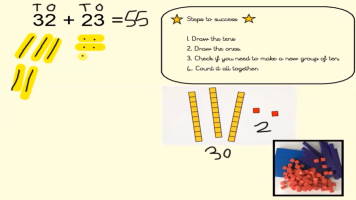
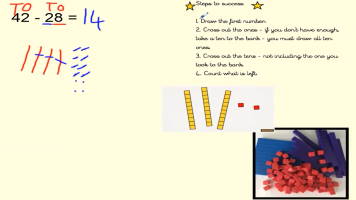
Subtraction
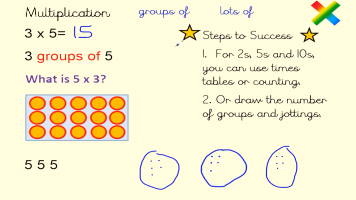
Multiplication
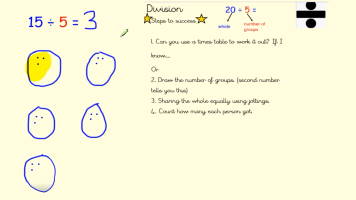
Division
Fractions

Key Stage Two
Formal Method for Addition

Formal Method for Subtraction - No Exchange

Formal Method for Subtraction - Using Exchange

Key Stage Two - Short Multiplication

Key Stage Two - Long Multiplication

Key Stage Two - Grid Method - Single Digit

Key Stage Two - Grid Method - Two Digits

Key Stage Two - Short Division

Key Stage Two - Long Division

Useful Links

x
x

x

x

x
Click the images to link
Click the image above to view our web page of links
Click the image above to view the digital booklet
Click the image above to view the digital booklet

Click the image above to link to the White Rose BARVEMBER webpages