History

HISTORY
National Curriculum [2014]: The Purpose of History:
A high-quality history education will help pupils gain a coherent knowledge and understanding of Britain’s past and that of the wider world. It should inspire pupils’ curiosity to know more about the past. Teaching should equip pupils to ask perceptive questions, think critically, weigh evidence, sift arguments, and develop perspective and judgement. History helps pupils to understand the complexity of people’s lives, the process of change, the diversity of societies and relationships between different groups, as well as their own identity and the challenges of their time.
INTENT
History Curriculum at Cottesmore St Mary
At Cottesmore St Mary, we believe history is a fascinating and exciting subject which has the potential to teach us all not only about the world and the past but also about our communities and ourselves. We have purposefully created a knowledge rich curriculum and have defined the essential knowledge, concepts and skills that pupils need to be educated citizens who understand the past through various perspectives.
We have sequenced the topics to be taught in a chronological order to deeply embed the key skill of chronology. We have carefully chosen interesting and varied topics that are embedded with local history and that reflect our school context. We ensure we have a diversity of people throughout the curriculum but we have also included a specific Civil Rights topic to teach black history. We provide a range of depth and overview studies and ensure the children know the difference. Overview refers to a topic which includes various periods in history that have the same theme and can be directly compared and contrasted. Depth is a topic that looks into one period in history and various aspects of that period. In our School, Children are engaged and inspired by a bespoke history curriculum which draws on significant aspects of the history of the wider world: the nature of ancient civilisations; the expansion and dissolution of empires; characteristic features of past non-European societies; achievements and follies of mankind and reflects our locality.
Chronology of History at Cottesmore
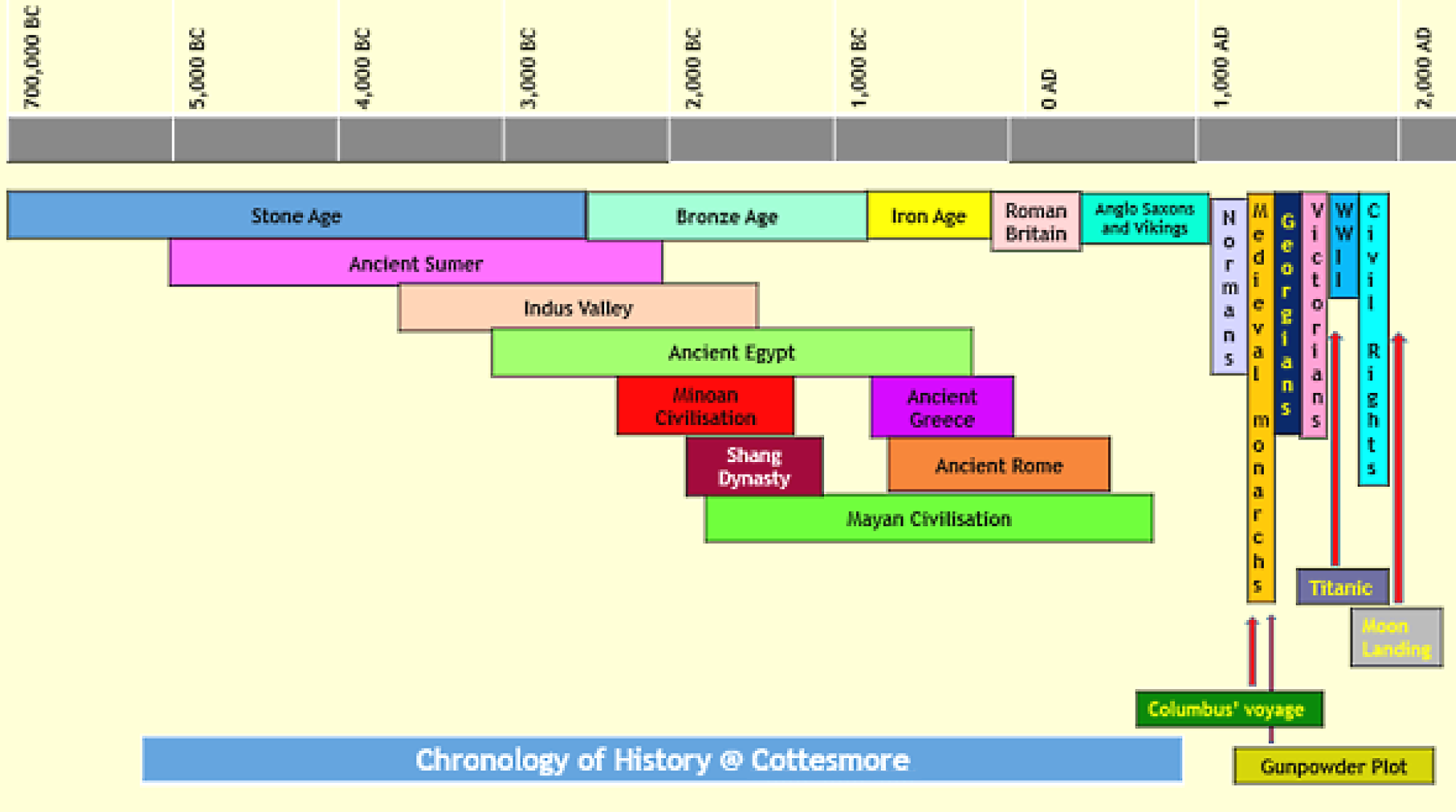 Click image to view a larger version
We believe history helps pupils to understand the complexity of people’s lives, the process of change, the diversity of societies and relationships between different groups. It also helps children gain a sense of their own identity within a social, political, cultural and economic background. Local history is threaded throughout our curriculum and we want our children to develop an appreciation for the people and events that are part of our local, national and international history. This is done through explicit history teaching, as well as, whole-school enrichment events. Learning history at Cottesmore St Mary not only prepares the children for studying the subject at secondary school, but inspires them to understand the relevance of the subject at our school, history is real and relevant and children learn about what careers paths the subject supports: historian, museum curator, author, archeologic, teacher, a documentary film maker, conservator.
Within our school, we celebrate the diversity of our pupils at every opportunity. We want all children, no matter their background, to accumulate knowledge, behaviours, and skills that draw upon and demonstrate their cultural awareness, knowledge and competence; we believe this is one of the key ingredients a pupil will draw upon to be successful in society, their career and the world of work. Cultural capital also gives them power. It helps children achieve goals, become successful, and rise up the social ladder without necessarily having wealth or financial capital. Cultural capital is having assets that give children the desire to aspire and achieve social mobility whatever their starting point.
What History topics do we teach?
History at Cottesmore is a discrete subject and is taught in half-termly topics with each year group studying three topics every year. Each topic comprises six lessons.
 Click image to view a larger version
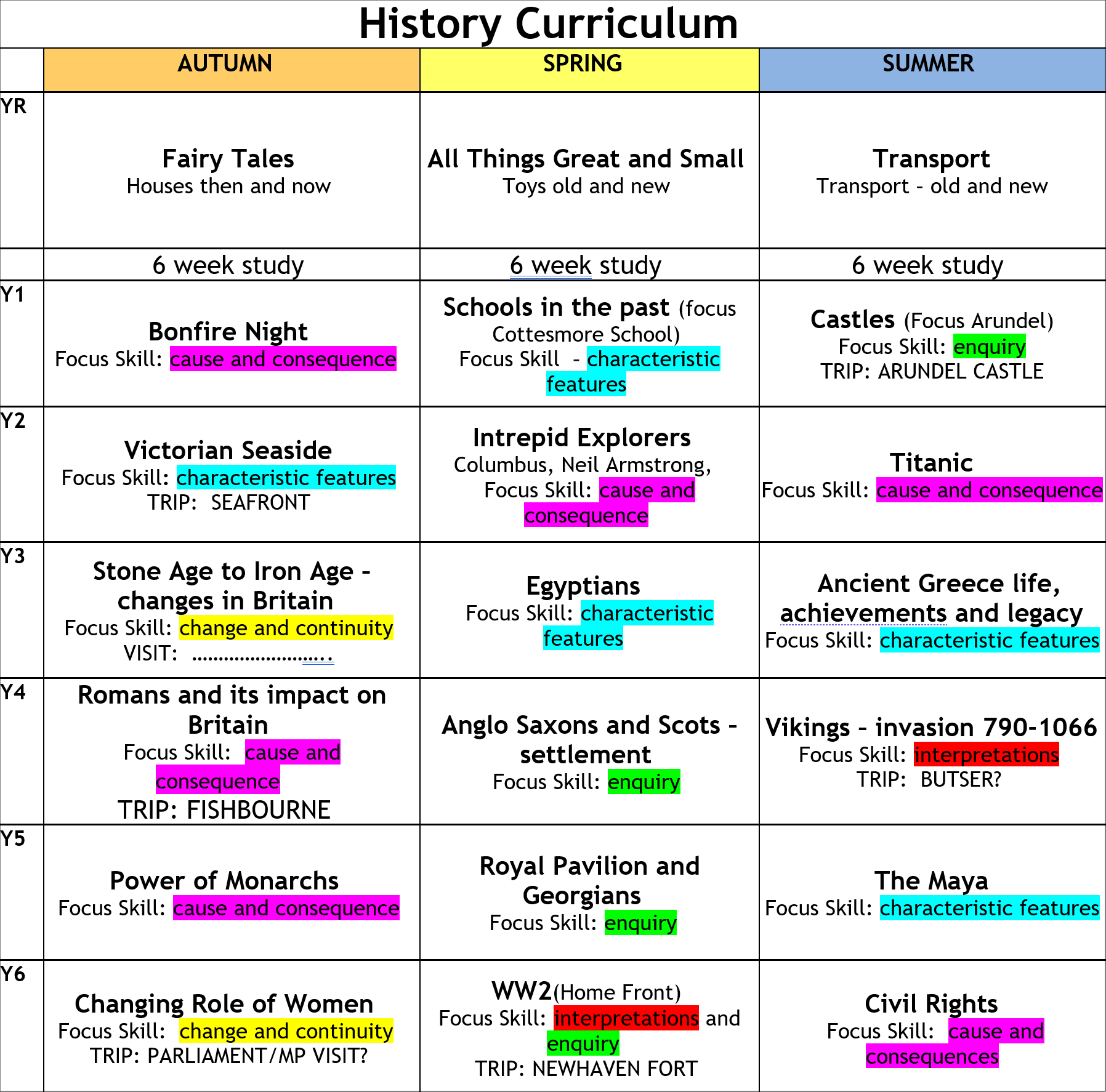
In the EYFS children learn about the past and present e.g. by talking about the lives of the people around them and their roles in society; knowing some similarities and differences between things in the past and now, drawing on their experiences and what has been read in class; understanding the past through settings, characters and events encountered in books read in class and storytelling.
Across Key Stage 1, children begin to develop an awareness of the past using historical vocabulary. They build upon EYFS by studying people and events, such as; Guy Fawkes in our Bonfire Night topic, the Battle of Hastings and William the Conqueror. They begin to identify similarities and differences between different time periods, for example, in our Schools in the Past and Intrepid Explorers topics. Children learn some of the ways in which we find out about the past and how events studied fit into the chronological framework.
Within Key Stage 2, children build on prior knowledge and continue to develop chronologically secure knowledge of British, local and world history, for example, in Year 4 children study the invasion of Romans, Anglo Saxons and Vikings developing concepts such as conquest, settlement and invasion. Children learn to develop historically valid questions, identifying contrasts and trends over time, and make connections. Children also learn how our knowledge of the past is constructed through a range of sources and begin to question the validity of the sources.
IMPLEMENTATION
How is history taught at Cottesmore St Mary?
History has a high profile at our school and we believe that through high-quality teaching, engaging artefacts and wider enrichment, children will ask perceptive questions, think critically, weigh evidence, sift arguments and develop perspective and judgement. Through our history teaching, the children will be exposed to memorable, interesting topics designed to develop their curiosity about the world. We recognise history as its own subject with its own discipline and as a result a history lesson at Cottesmore St Mary is recognisable and different from other subjects.
Through explicit, direct teaching of subject-specific vocabulary, knowledge and skills relevant to the learning, children can integrate new knowledge into larger concepts. They are given opportunities to investigate sources, develop their questioning skills, have in-depth discussions and draw conclusions. All learning will start by revisiting prior knowledge. This will be scaffolded to support children to recall previous learning and make connections.
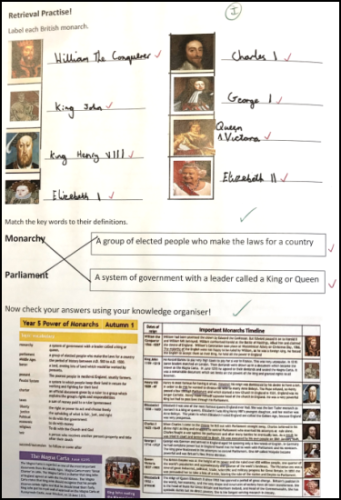
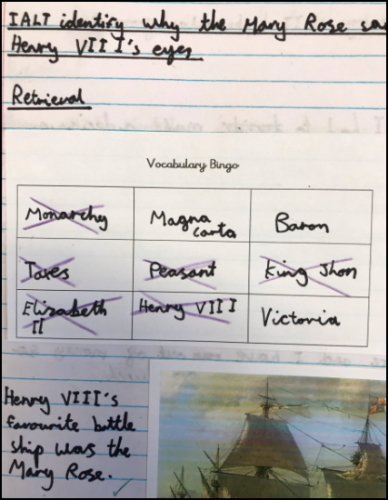
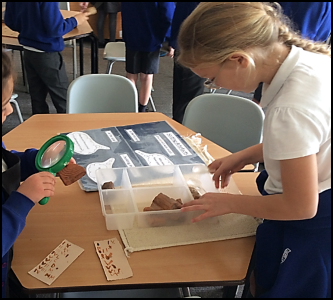
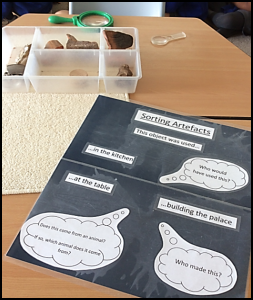
Children use knowledge organisers for each topic which supports them to retain new facts and vocabulary in their long-term memory. We give children the opportunity to develop as historians using; real artefacts, photos, videos, fieldwork and people. Careful thought and consideration is taken when selecting resources and we pre-select sources to ensure children are exposed to a broad range across the curriculum.
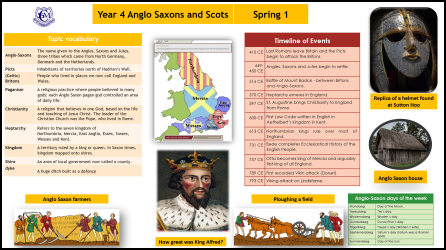

Click on the images above to view larger versions
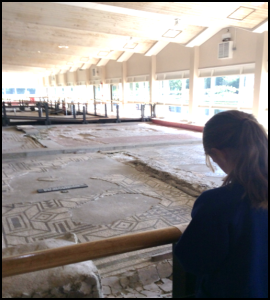
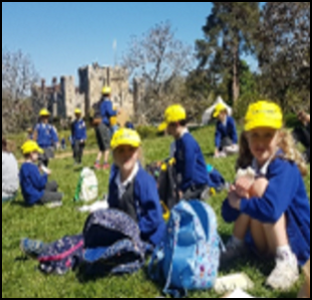
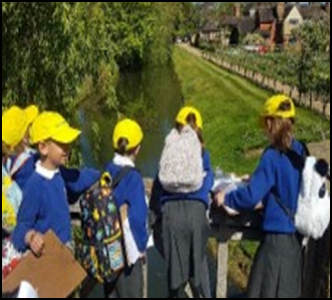
Our historians will be given a variety of enrichment and experiences both in and out of the classroom to create memorable learning opportunities and to further support and develop their understanding. In KS1, children visit Arundel Castle and learn about the Howard family, including St Philip Howard, the 13th Earl of Arundel and whom our hall at Cottesmore is dedicated to. They also have a Punch and Judy visit and learn through real photos and videos of our school in the past. In KS2, history is brought to life through workshops such as; Stone Age day, Greek Day, visits from an Anglo Saxon archaeologist, and Maya workshops. They also have trips across KS2, such as; Fishbourne Palace and Newhaven Fort. These enrichment experiences allow children to learn in a memorable, engaging way and consolidate the knowledge, skills and concepts taught.
At Cottesmore St Mary, we implement an inclusive curriculum that meets the statutory requirements of the National Curriculum whilst inspiring a love of the past. Our curriculum is well-planned and structured, provides literacy-rich, cross-curricular opportunities and ensures progression and depth in learning. We adopt a spiral curriculum where children are given the opportunity to further develop skills and concepts taught. This allows the children to deepen their knowledge, skills and concepts by building on previous lessons. We believe in a mastery approach to learning, offering challenge for all, including the higher attaining children and scaffolding for SEN children and of all home backgrounds. Our history curriculum promotes children’s Spiritual, Moral, Social and Cultural development, ensuring that they are reflective and responsible citizens.

All teachers follow a carefully sequenced long-term plan designed specifically with our community in mind. This ensures that children learn history in a carefully sequenced pattern and that progress is made from year to year. Topics are mapped out chronologically in KS2 to enable children to build upon their knowledge and skills previously taught. Key concepts have been identified and shared with teachers, highlighting new or revisited concepts. Therefore, teachers can explicitly make links when teaching a concept that has been taught previously. Concepts and skills are regularly revisited throughout the curriculum so that children gain an increasingly sophisticated understanding and embed the learning.
Challenge in subject
Staff have a shared understanding of what deeper learning looks like in all subjects and we have identified Indicators of Deeper Learning, including connected learning, critical thinking, consistent and confident application of skills and understanding of concepts, problem solving and independence. To provide a challenge for higher achieving children, we provide ‘What if’ challenges. These help children to achieve mastery level, as the higher order thinking questions give pupils the opportunity to develop and share their deeper understanding.
IMPACT
In agreement with OFSTED [handbook 2019], we define progress as ‘knowing more and remembering more’. Therefore, we have clearly identified the knowledge that is most important for pupils to learn and remember. Teachers use formative assessment to check what has been learnt and that learning has been remembered. It is used by teachers to provide feedback, to adjust teaching and learning and to identify pupils falling behind in the learning journey. At key points across and within the Key Stages, we use summative assessment to check pupils’ knowledge of the history content they have learned and this ensures that all pupils are making progress in their knowledge of history. Teachers are clear what end points the curriculum is building towards and what pupils need to know and be able to do to reach those end points. Assessments of core knowledge, skills and concepts are recorded at the end of each topic, and become the starting points for future topics. At the end of each year we report to parents on their child’s attainment in history.
An example of skills progression in History

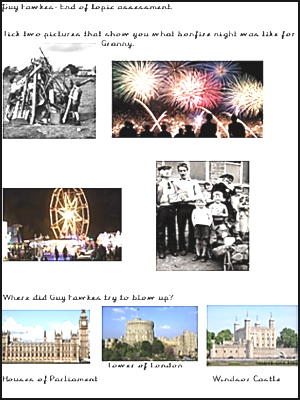
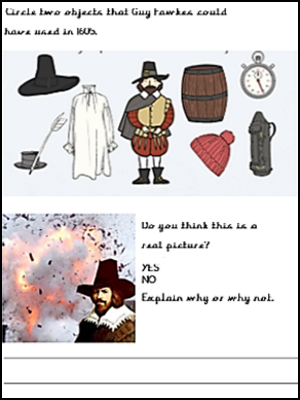
Example of end of unit assessments for history: